
OpenAI Acquired OpenClaw: Why Workflow Infrastructure Is Where the Value Is Migrating

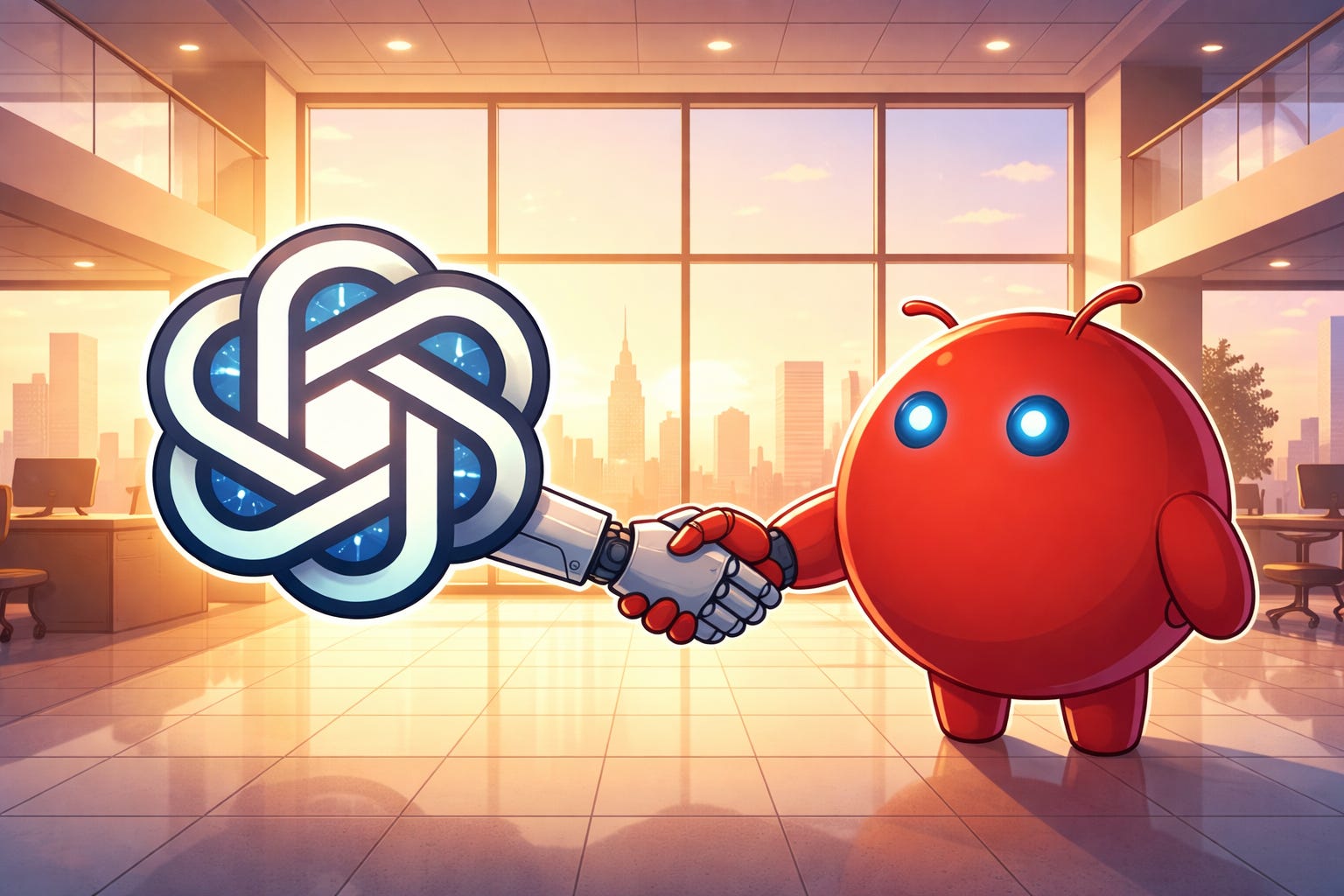
On February 15, 2026, Sam Altman announced that OpenAI had acquired OpenClaw and that Peter Steinberger was joining the company.


The deal closed quietly—no press release, no fanfare. Just two tweets. But the signal is unmistakable: OpenAI is acquiring workflow infrastructure, not AI capability.
What OpenAI Actually Acquired
OpenClaw is an open-source AI agent framework that executes multi-step tasks across platforms. Created by Peter Steinberger as a side project, it quickly gained traction among developers and productivity enthusiasts looking for agents that could actually do things, not just talk about them.
Key capabilities:
Cross-platform orchestration: Connects Google Sheets, Gmail, Slack, file systems, browsers, and custom tools
Persistent memory: Recalls past interactions over weeks and adapts to user habits for hyper-personalized workflows
Multi-step execution: Can read data from one platform, process it, and execute actions across multiple systems autonomously
Community validation: ~50,000 users, active contributors, real production deployments
The distinguishing feature: OpenClaw doesn’t live in a single application. It orchestrates workflows across disconnected platforms—reading from Google Sheets, composing emails in Gmail, posting to Slack, and scheduling calendar events in a single automated sequence.
OpenAI didn’t acquire a product with paying customers. They acquired proven infrastructure with community adoption and a clear strategic thesis: the value of AI agents lies in cross-platform orchestration, not in single-application features.
The Security Trade-Off
OpenClaw’s power derives from its access. To automate workflows across email, spreadsheets, messaging platforms, and file systems, the agent requires permission to read from and write to each surface. This creates inherent security questions about how much access any AI agent should be granted, particularly in enterprise environments operating under regulatory frameworks and fiduciary duties.
The framework illustrates a fundamental paradox: increasing capability requires increasing access, and increasing access introduces compounding risk. For individuals and small teams, the calculus may be acceptable. For enterprises managing sensitive customer data, financial systems, or regulated information, the risk profile changes entirely.
Sidebar: My OpenClaw Experiment
The Setup: Last week, I built an AI-powered CRM for Good AI Capital’s LP pipeline using OpenClaw. The framework runs locally on my Mac, connected to a Google Sheet tracking LP relationships, with a Telegram bot for mobile access and Gmail integration for relationship history.
How it works: When I need to follow up with an LP, I message the bot to draft a personalized email based on our past exchanges. The agent reads the Google Sheet, pulls our email history, and generates a contextual draft for review.
The ROI:
Replaced: $150/month Salesforce or PipeDrive subscription
Cost: ~$15/month in API calls
Setup time: 2 hours
Security decision: Granted read access to Sheets and Gmail, but not write access to send emails without human review
The irony: Two days after building this system, OpenAI acquired OpenClaw. I’m now uncertain whether my LP CRM will continue functioning—but the broader lesson is clear: I was using infrastructure that OpenAI found valuable enough to acquire.
The AI Race Is Entering the Infrastructure Phase
The OpenClaw acquisition is part of an accelerating pattern. In December 2025, NVIDIA acquired Groq for approximately $20 billion. Groq specializes in inference efficiency—specifically, low-latency, single-batch processing optimized for agentic workflows. In January 2026, Meta invested $14.3 billion in Scale AI, targeting data infrastructure and high-quality training data as the binding constraint. In February 2026, OpenAI hired Peter Steinberger from OpenClaw, betting on cross-platform workflow orchestration as essential to agent deployment.
OpenAI isn't alone. Anthropic’s release of Claude Cowork the same week reinforces the same structural shift. Agent capabilities are increasingly absorbing the application layer. As workflow functionality becomes native to foundation model providers, value migrates to the layers that control access, integration, and trust.
Markets reacted quickly, repricing application-layer software companies. But the more important signal isn’t SaaS disruption. It’s that infrastructure — not features — is becoming the strategic control point.
Three acquisitions and one major product launch across three months — all targeting the same thing: constraint layers.
The pattern suggests hyperscalers are no longer attempting to build every component of the AI stack internally. Instead, they are acquiring proven infrastructure that solves specific deployment bottlenecks. Groq had inference infrastructure. Scale AI had data infrastructure. OpenClaw had workflow infrastructure. All three addressed problems that would have required two to three years to solve through internal development.
Models are commoditizing. GPT-4, Claude, and Llama are all functionally “good enough” for most enterprise applications. Inference costs continue to decline. AI capability has become abundant and inexpensive.
Deployment infrastructure has not. This creates urgency for hyperscalers. They possess the models. They control the compute. What they require now is deployment infrastructure, and they require it immediately.
The AI race is not slowing. It is entering a new phase focused on infrastructure rather than capability.
The Constraint-Layer Investment Thesis
At Good AI Capital, we track where AI deployment bottlenecks—not where AI capability exists. Our investment thesis centers on constraint layers: the infrastructure, compliance, and integration barriers that limit deployment at scale.
The trust and security constraint has emerged as a primary enterprise deployment blocker. How do enterprises grant agents sufficient access to be useful without creating unacceptable risk?
This isn’t theoretical caution. In healthcare, an AI agent with access to electronic health records could modify patient records incorrectly, transmit protected health information to unauthorized recipients in violation of HIPAA, or recommend incorrect medication dosages. The model might be ready, but the trust infrastructure—audit trails, role-based access controls, liability frameworks, regulatory compliance mechanisms—requires years to build.
The deployment pattern we observe across enterprises follows a predictable sequence:
Proof-of-concept deployments demonstrate agent functionality in sandboxed environments with no access to production systems
Procurement teams initiate security reviews to evaluate access requirements and risk exposure
Legal, compliance, and information security stakeholders conduct formal risk assessments
Integration projects extend 12 to 18 months as organizations build trust, infrastructure, and human oversight mechanisms
Limited rollouts deploy agents with restricted access and mandatory human review for high-stakes actions
The model is ready in six months. The trust infrastructure requires three years.
This trust constraint exists alongside other well-documented deployment bottlenecks. Hyperscalers are signing 20-year power purchase agreements because electrical power has become a binding constraint on data center expansion. Healthcare AI systems achieve high accuracy in laboratory settings but require integration with Epic or Cerner EHRs, HIPAA-compliant infrastructure, clinical validation studies, and physician workflow redesign before deployment. Agentic workflows impose low-batch inference economics where processing individual requests sequentially costs significantly more per token than batch processing.
Tools like OpenClaw and Cowork solve horizontal orchestration by connecting modern SaaS applications for individuals and small teams. But they do not solve the enterprise workflow integration challenge. That requires vertical-specific platforms that navigate regulatory complexity, integrate with decades-old legacy systems, and establish a comprehensive trust infrastructure for high-stakes environments.
Recent acquisitions reflect this constraint-layer focus: NVIDIA acquired Groq to address inference efficiency. OpenAI acquired OpenClaw to address workflow orchestration and accelerate its trust layer development. The pattern is clear—hyperscalers are acquiring infrastructure that removes bottlenecks limiting AI deployment at scale.
At Good AI, we invest in platform companies that solve these constraint-layer problems:
Security and trust infrastructure for agent deployment under regulatory oversight—access control systems, audit trails, human-in-the-loop approval workflows, and liability frameworks.
Vertical workflow integration platforms that provide pre-built integration with Epic, Guidewire, SAP, and legacy systems alongside regulatory compliance frameworks that eliminate the need for each enterprise to spend years building custom integration.
Physical infrastructure enabling data center expansion and reducing compute costs—grid relief software, power generation solutions, and inference optimization tools.
These are not glamorous investments. But they represent what enterprises actually pay for when deploying AI at scale. The constraint layer is where adoption bottlenecks. It is also where value accrues.
The Competition Is Fierce—And We’re In the Right Lane. The pace of infrastructure acquisitions—Groq, Scale AI, OpenClaw—validates what we’ve been building toward. The competition is intensifying. Hyperscalers are moving aggressively. Capital is flowing into AI infrastructure at an unprecedented scale.
We’re excited. Not because the path is easy, but because the market is finally pricing what we’ve been tracking: AI capability is abundant, deployment infrastructure is scarce, and the companies solving constraint-layer problems will capture disproportionate value as enterprises race to operationalize AI at scale.
The bottleneck has shifted from “can we build the model?” to “can we trust it with access to our systems?” That’s the constraint layer. That’s where value is migrating. And that’s the lane we’ve chosen.
This shift is consistent with what we’ve been observing across power, inference, and integration layers.
In August 2025, we identified the power crunch as AI’s binding constraint, arguing that electricity—not compute—would bottleneck deployment. In December 2025, NVIDIA’s $20 billion acquisition of Groq validated our inference efficiency thesis. The OpenClaw acquisition is the latest confirmation. The constraint layer is real. And we’re investing where the bottlenecks are.
If you’re building infrastructure that solves constraint-layer problems—agent security, vertical workflow integration, or physical infrastructure enabling AI deployment—reach out: darwin@goodai.capital.
The "workflow infrastructure is where value migrates" thesis maps perfectly onto what's happening in health AI right now. Models are commoditizing fast — but the compliance, audit, and PHI governance layer sitting underneath the workflow is where health AI companies are building durable moats. OpenClaw makes sense as a move: whoever owns the orchestration layer owns the data lineage, and data lineage is the audit trail. Great analysis Darwin.
Very cogent analysis, Darwin! Thanks for the clarity.
I'm an OpenClaw early adopter and enthusiast. I've created an interface to enables normies to implement and operate OpenClaw with more confidence, especially focused on ensuring enterprise-level security -- see ClawNanny.com. I just published a security-analysis whitepaper on OpenClaw's vulnerabilities and mitigation measures I'm implementing. Exec summary: https://clawnanny.com/docs_viewer?markdown_url=/static/docs/ClawNanny_OpenClaw_Enterprise_Security_Whitepaper_Summary.md
Cheers,
--Daniel